
Earl Lintels
Galvanised Throughbolt Anchors
Galvanised Throughbolt Anchors
Share
Couldn't load pickup availability
Galvanised Throughbolt Anchors
Click here for product installation and datasheet
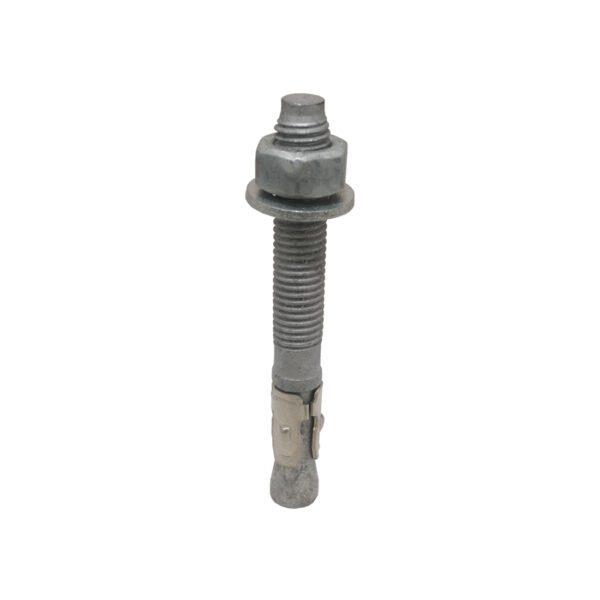
Hot-dip galvanised throughbolt anchors for fast and secure fixing into non-cracked concrete. Suitable for installing structural steelwork, base plates, brackets, machinery, racking, railings and other heavy-duty fixtures where a mechanical concrete anchor is required.
JCP throughbolts are torque-controlled expansion anchors designed for through-fixing. The anchor can be inserted directly through the fixture and into the drilled hole, reducing the need to mark, remove and reposition heavy or awkward components.
The drill-hole diameter is the same as the nominal bolt diameter, helping to simplify drill-bit selection. For example, an M12 throughbolt requires a 12mm drilled hole, while an M16 throughbolt requires a 16mm hole. Always confirm the required hole depth, fixture clearance hole and installation torque for the exact anchor size before installation.
Hot-Dip Galvanised for Improved Corrosion Protection
These steel throughbolts are hot-dip galvanised to a minimum coating thickness of 45 microns in accordance with BS EN ISO 1461:2009, providing improved corrosion resistance compared with standard zinc-plated concrete anchors.
They are suitable for a wide range of internal and external applications, subject to the required service environment and project specification. Suitability for highly corrosive, coastal or chemically aggressive environments should be assessed separately.
How Throughbolt Anchors Work
A throughbolt uses an expansion sleeve and tapered cone to create a mechanical fixing inside the concrete.
The anchor is inserted through the fixture and into a correctly sized, cleaned hole. As the nut is tightened to the specified torque, the cone is drawn into the three-way expansion sleeve. The sleeve expands against the sides of the drilled hole, securing the anchor and clamping the fixture firmly against the concrete.
Unlike a resin anchor, a throughbolt does not require a chemical cartridge or curing period. The connection can be completed once the anchor has been correctly installed and tightened, making throughbolts a practical choice for fast site installation.
Features
- Heavy-duty mechanical concrete anchor
- Hot-dip galvanised steel construction
- Minimum galvanised coating thickness of 45 microns
- Suitable for non-cracked concrete
- Suitable for concrete strengths from C20/25 to C50/60
- Fast and secure through-fixing installation
- Three-way expansion sleeve
- Drill-hole diameter matches the nominal bolt diameter
- No resin cartridge or curing time required
- Supplied with nut and washer
- Reaction to fire Class A1
- Suitable for a wide range of fixture thicknesses and embedment depths
- Installed using standard SDS drill bits and a calibrated torque wrench
JCP specifies its hot-dip galvanised throughbolts for non-cracked concrete from strength class C20/25 to C50/60.
Typical Applications
Galvanised throughbolt anchors are commonly used for fixing:
- Structural steelwork
- Steel base plates
- Columns and posts
- Brackets and support frames
- Machinery and production equipment
- Warehouse racking
- Railings and barriers
- Temporary fencing and barriers
- Signs and steel posts
- General metalwork to concrete
- Industrial and construction fixtures
The correct anchor diameter, length and embedment depth must be selected for the fixture thickness, concrete strength and applied loads.
Choosing the Correct Throughbolt Size
A throughbolt is described by its thread diameter and overall length. Both measurements must be considered when selecting an anchor.
Anchor diameter
The diameter influences the anchor’s potential tensile and shear resistance. Larger throughbolts may provide greater resistance, but the final capacity depends on the concrete, embedment depth, spacing, edge distances and installation conditions.
Anchor length
The overall length must provide sufficient embedment into the concrete while also allowing for:
- The thickness of the fixture
- Any packing, shims or grout beneath the fixture
- The washer and nut
- The required effective embedment depth
Do not select the anchor length using the fixture thickness alone. The minimum concrete thickness and required drilled-hole depth must also be checked.
Standard and reduced embedment
Some shorter JCP throughbolt sizes use reduced embedment depths and therefore have different load capacities, minimum spacings and edge-distance requirements. Always use the technical data applying to the exact product selected rather than assuming every anchor of the same diameter has the same resistance.
Throughbolts or Resin Anchors?
Throughbolts are often preferred where quick installation is required and the concrete has adequate edge distances, spacing and thickness. Once correctly tightened, there is no resin curing time to wait for.
Resin anchors are expansion-free and may be more appropriate where anchors need to be positioned closer to an edge, at reduced spacings or in substrates and conditions covered by the resin’s approval.
Neither fixing type is automatically better for every connection. Selection should be based on the substrate, applied tensile and shear loads, edge distances, spacing, fixture thickness, required embedment and environmental exposure.
Installation
- Drill into the concrete where required using the specified drill-bit diameter and hole depth.
- Clean the drilled hole to remove concrete dust and drilling debris.
- Insert the throughbolt through the fixture and lightly hammer it into the concrete until it is correctly seated.
- Install the fixing and tighten the nut using a calibrated torque wrench to the installation torque specified for the anchor size.
Do not use an impact wrench for final tightening unless the manufacturer’s installation instructions expressly permit it. Excessive or insufficient torque can prevent the anchor from achieving its intended performance.
Important Information
These galvanised throughbolts are intended for use in non-cracked concrete. They should not be assumed suitable for cracked concrete, masonry, brickwork, blockwork or hollow substrates.
The resistance of a throughbolt cannot be determined from its diameter alone. The design must consider:
- Concrete strength and condition
- Tensile and shear loads
- Concrete member thickness
- Effective embedment depth
- Fixture thickness
- Anchor spacing
- Distance from concrete edges
- Installation torque
- Corrosion exposure
- Combined loading
The information above is intended as general guidance. Structural and safety-critical fixings should be designed or approved by a suitably qualified person using the technical data for the exact throughbolt selected.